Hera-MI develops AI software for 2D mammography and tomosynthesis, combining Breast-SlimView® diagnostic reading support with Mammography Technical Evaluation (MTE) for image-quality assessment.
About Hera-MI
Hera-MI is a French medical technology company specialising in AI-assisted mammography and breast cancer detection. Its Breast-SlimView® software supports radiologists in interpreting 2D mammograms and digital breast tomosynthesis (3D).
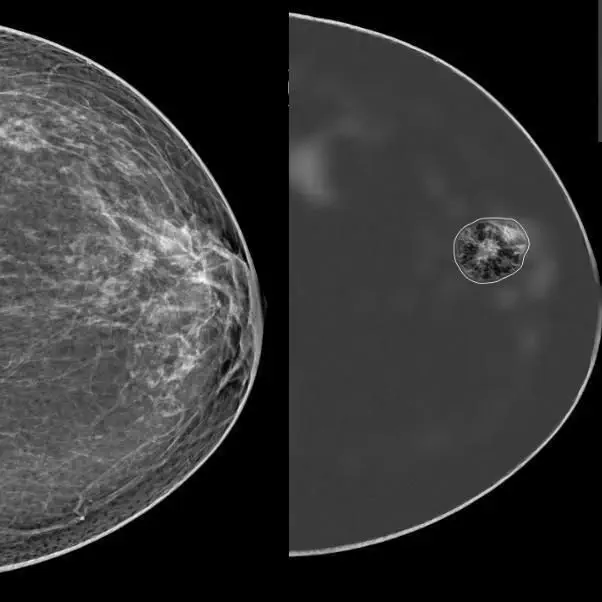
The software uses a patented technique called negativation, which suppresses normal breast structures in AI-generated images to make potentially suspicious areas more visible. Combined with Mammography Technical Evaluation (MTE), Hera-MI offers solutions for both diagnostic reading support and mammography image-quality assessment.
Use cases
Breast screening creates a large reading workload in 2D mammography and tomosynthesis. Radiologists must find small suspicious areas among overlapping normal tissue, spend time on unproblematic cases, and work with images whose positioning and compression vary from one exam to the next.
Normal breast structures can mask suspicious areas; reading support should show only the information that matters.
Less time spent on unproblematic cases leaves more time for the complex ones that need the radiologist's expertise.
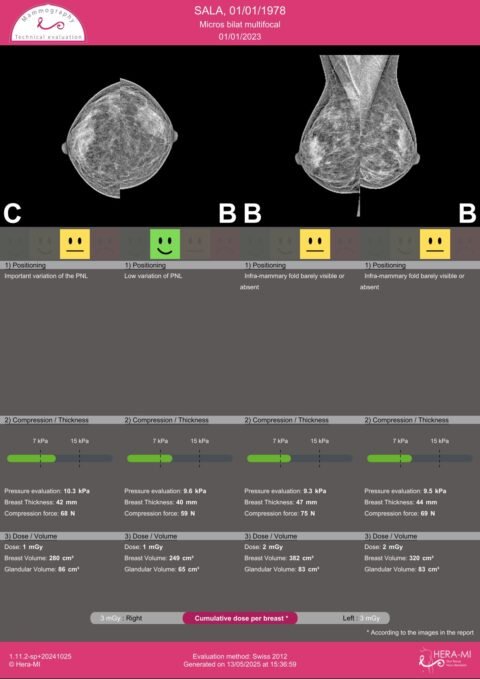
Positioning and compression differ between exams; objective quality feedback helps radiographers standardise good practice.
Products
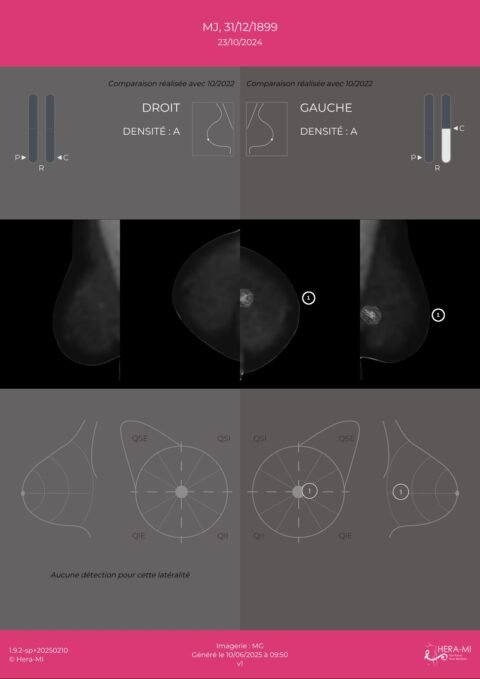
Breast-SlimView® – decision support for 2D and 3D mammography: negativated images, BI-RADS breast density, a three-level risk score and comparison with prior exams.
Mammography Technical Evaluation (MTE) – image-quality assessment tool for 2D mammography and tomosynthesis. It automatically evaluates breast compression, positioning and technical artefacts, helping radiographers assess acquisition quality and standardise good practices.
Key benefits
Breast-SlimView® runs automatically, with no user action, and delivers its results through the radiologist’s usual mammography viewer in standard DICOM. It is installed within the centre’s own infrastructure without additional hardware, and one suite covers both reading support and image-quality assessment.